
How Lincoln County Property Tax Records Divide the Work
Lincoln County property tax research works best when you split it in two. The Appraiser holds the assessment side: parcel identity, classification, land use, improvements, and valuation. The Treasurer holds the collection side. Its public tax search is the route to a real-estate account, covering tax years, taxpayer matching, and filters for current or delinquent status.
| Field | What It Shows | Where |
|---|---|---|
| Appraised value | County estimate made for tax administration | Appraiser portal and card |
| Assessed value | Tax base after the lawful class rate is applied | Appraiser record |
| Class and land use | How the parcel is categorized for assessment | Appraiser record |
| Tax year and statement | The period and account being billed | Treasurer tax search |
| Current or delinquent status | Whether the selected account is shown with taxes due | Treasurer tax search and office |
Neither figure is a sale price. Kansas guidance separates appraised value, the assessment rate, assessed value, and the levy that goes into the final tax calculation. For a fuller walkthrough of those terms, see the Lincoln County property value guide.
The Lincoln County Tax Portal Has Two Search Paths
The Lincoln County tax search form offers a deep set of fields. Set the tax type to Real Estate (RL) before entering any parcel criteria. The same form also handles personal property, oil and gas, trucks, minerals, and state-assessed utilities. The wrong setting returns the wrong records. For a first name search, the portal itself suggests starting with a last name alone. The official tax-search form appears here.
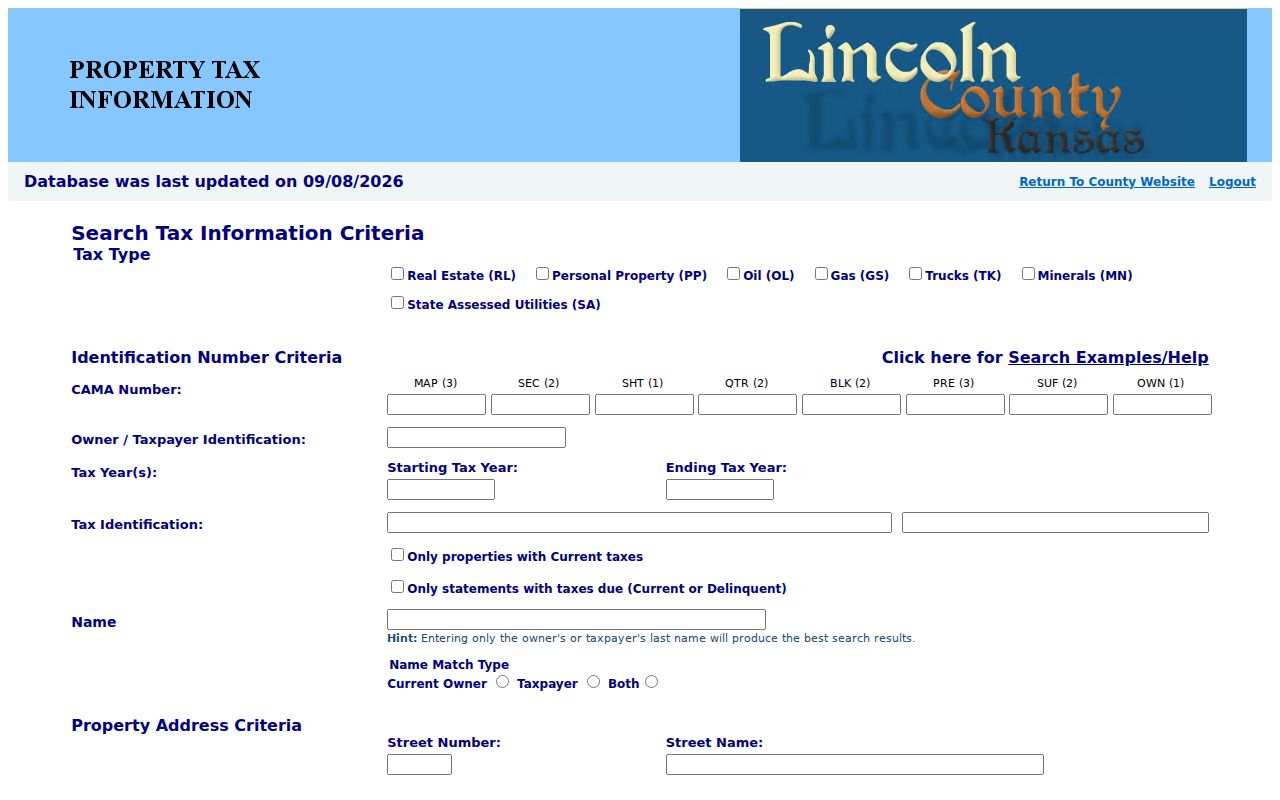
The image shows the local search route. A live account still governs the balance and status.
| Search group | Visible choices | Best use |
|---|---|---|
| Name | Name plus Current Owner, Taxpayer, or Both | Resolve who the account is indexed under |
| Address | Street Number, Street Name, Direction, ZIP Code | Find a known site address |
| Tax period | Starting and Ending Tax Year | Limit the account history reviewed |
| Parcel keys | CAMA segments, Tax Identification, Quick Ref | Run the most exact known identifier |
| Land description | Subdivision, Block, Lot, Section, Township, Range | Find platted or rural land |
| Status | Current taxes or statements with taxes due | Focus on an unpaid-status question |
The portal's result columns carry the current figures. Check the live statement before quoting any amount, penalty, payment, or sale indicator.
Run a Lincoln County Property Tax Search Carefully
Start narrow. Save the exact query you ran. The portal is dynamic, and its database date shifts over time. A good source note lists the access date, the tax type selected, the tax years, the filters, and the identifier used, so the same Lincoln County property tax lookup can be repeated later.
- Select Real Estate (RL), then enter a Quick Ref, CAMA value, address, or owner name.
- Limit the tax years and choose the current-owner, taxpayer, or both setting.
- Use the status checkboxes only when the question is about taxes due.
- Open the matching account and verify the statement and payment position with the Treasurer.
- Compare parcel identity and value fields with the Appraiser portal.
- Assessed value
- The amount produced from appraised value and the lawful assessment rate.
- Mill rate or levy
- The rate applied in calculating tax from assessed value.
- Exemption
- Lawful relief or treatment that changes the taxable amount when approved.
- Tax lien
- A claim tied to unpaid tax, distinct from a deed conveying ownership.
Lincoln County Uses a January 1 Valuation Date
The Appraiser values real property as of January 1. The county describes annual revaluation and a cycle in which each parcel is physically inspected at least once every six years. New construction, demolition, additions, land-use changes, and sales information can become part of the appraisal work.
That timing explains why records from different offices may not refresh together. A deed can be recorded before the Appraiser display changes, and a tax statement belongs to its own year. Keep the deed recording date, portal database date, appraisal date, notice date, and payment date separate.
Lincoln County Property Tax Deadlines Split the Bill
Real-estate tax becomes due November 1, per the Treasurer. Pay the full amount by December 20, or split it. First half due December 20, second half due May 10. Miss the December 20 first-half date and the entire amount comes due with interest.
A calendar alone cannot tell you where an account stands. Whether payment posted, an adjustment landed, or a protest changed the bill shows only in the live account or from the Treasurer. Save the statement date and recheck shortly before any purchase or closing.
Partial payments are accepted, including on delinquent tax, the county collection page says. Ask the Treasurer how a partial payment gets applied. Get the current balance before sending funds. Vehicle-office hours post separately, so confirm the hours that fit a tax-record request. For the tax year, parcel identity, installment status, interest, and amount due, the mailed statement and live account remain the best evidence.
Delinquent Lincoln County Tax Is a Sequence
Delinquent real-estate taxes are published for three consecutive weeks in August, the county states. Foreclosure follows after three years for land and four years for residential land. Then comes public auction. One parcel's true status takes more than an old publication notice.
Keep the stages distinct: delinquency, newspaper notice, court foreclosure, auction, redemption, deed issuance, and later recording. Confirm the account with the Treasurer. Confirm the case with the court. Confirm any ownership change with the Register of Deeds. A notice alone does not prove a completed sale.
For an older delinquency, the Kansas Historical Society newspaper database covers Lincoln County by date range. Search the relevant August window and record the newspaper title, issue date, and parcel description. Compare that notice against the tax account and the court file. A sheriff's deed or other conveyance may have followed. Its recording reference ties the parcel back into the deed chain. Every step in the Lincoln County property records sequence deserves its own source.
The 2025 Lincoln County Study Shows Parcel Differences
The county's 2025 market study set a 0.07% residential inflationary trend countywide. Commercial conditions held stable to slightly upward. Vacant land stayed stable. But land values rose at Wilson Lake and Prairie View Estates on the strength of sales. Those figures describe broad areas, not any single parcel.
Read a lake-area or subdivision tract through its own class, acreage, land use, improvements, and tax unit. The study gives context only. The parcel card and the mailed notice carry the county's actual value for that property.
Classification often explains a gap that a trend percentage cannot. Kansas assesses different property classes at different rates: residential, agricultural-use, vacant, nonprofit, utility, commercial or industrial, and other. So check the parcel's real class against the current state reference. Applying a familiar residential rate to every Lincoln County tract invites error.
The levy sits on the tax side and shifts by tax unit. A changed bill can trace back to value, class, levy, exemption treatment, or an adjustment. Compare matching tax years and keep the source dates. When two official values disagree, send each disputed field to the office that maintains it. Do not average them.
Contest a Lincoln County Assessment, Not the Deed
Valuation notices go out on or before March 1, per the Appraiser calendar. Taxpayers then generally have 30 days from the mailing date to request an informal meeting. Trust the notice, not the standing calendar. Its mailing date controls the real deadline.
Come prepared. Bring the notice, the parcel card, photographs, measurements, comparable sales or condition evidence. Bring anything showing a class or factual error. Paying under protest opens a separate route through the Treasurer. That route requires all tax or the first half paid by December 20, a protest form at payment, notarization, and filing with the Appraiser for scheduling.
A value protest fixes values, not deeds. Easements, legal descriptions, and ownership corrections belong to the recording or legal process. That holds even when the same bad fact sits on an appraisal card. Tax-payment disputes go to the Treasurer. Label the tax year on every notice and form. A mailed value notice, a payment date, and a later appeal can land in different calendar periods.
Build the packet from records that answer the disputed fact. Dated photographs and measurements support a condition or size claim. The parcel card shows the county's current entry, and sale documents prove a transaction. Match comparable sales properly where they matter. Keep copies of the form, the meeting notice, the evidence list, and the written result. If a notice arrives late, ask the Appraiser which deadline applies. Do not estimate from March 1.
Keep the payment-under-protest file separate. Note whether all tax or the first half was paid. Note when payment was accepted, when the notarized form went in, and which tax year it names. Balances can shift after payment, correction, or appeal. Pull a fresh account statement whenever the amount matters to a sale or closing.
Ask for written confirmation when a portal field reads oddly. Unfamiliar codes, duplicated tax-identification fields, or statement indicators deserve the Treasurer's interpretation, not guesswork.
Use the mailed notice. The 30-day informal-meeting period runs from its mailing date; confirm the current form and deadline with the Appraiser.