
Start a Lincoln County Property Records Search
Start at the Lincoln County Appraiser public portal. Continue as a public user. Search by an owner-name fragment, a full or divided street address, a Property number, a Quick Reference number, or the portal's segmented CAMA fields. A solid match supplies shared parcel vocabulary. The same identifier then opens the tax system, mapping, and a focused request to the recording office.
Keep every identifier and its source date. Lincoln County explains that parcel numbers may change after splits, combinations, and new plottings. An assessment description also may not match the controlling deed description. These property records complement each other. Appraisal data identifies and values a tax parcel, while a deed records a conveyance, the tax account tracks billing, and GIS provides geographic orientation.
- Search the Appraiser portal by address, owner, Property number, Quick Reference, or tract criteria.
- Record the returned identifiers, subdivision or legal-description wording, and any book, page, instrument, or ownership-date lead actually displayed.
- Run the same CAMA, name, address, subdivision, or rural description in the Lincoln County tax search.
- Use ORKA's current ArcGIS experience for parcel orientation, roads, water, and adjoining-parcel context.
- Ask the Register of Deeds for the precise deed, plat, lien, easement, or index entry, using the best identifiers and date range available.
Where Lincoln County Keeps Property Records
Three county functions answer different questions. The Register of Deeds keeps conveyances and recorded interests. The Appraiser identifies and values parcels, while the Treasurer maintains tax accounts and collection information. All three operate from the county courthouse address. For a record not published online, contact the office that created or holds it rather than asking another office to interpret it.
Lincoln County Register of Deeds
216 E Lincoln Ave
Lincoln, KS 67455
785-524-4657
The Appraiser Portal's Lincoln County Search Controls
The county's public CAMA portal is unusually flexible. Its owner field accepts any portion of a name. Address searching can use a single Full Address field or separate Street Number, Direction, Name, Suffix, and Postal Code controls. Identifier options run deep. They include Property number, Quick Reference, Book, Page, Instrument Number, and ownership-date limits, plus advanced property-record filters for subdivision, class, appraised-value range, acreage, soil unit, and land use.
| Starting clue | Portal control | Useful next match |
|---|---|---|
| Street address | Full Address or divided street fields | Property and Quick Reference numbers |
| Person or entity | Owner name, including a partial name | Address, subdivision, and parcel identity |
| Recorded reference | Book/Page or Instrument Number | Assessment-side parcel candidate |
| Rural tract | Subdivision, acreage, soil, or land use | Candidate list requiring legal-description checks |
The portal displays version and database timestamps. Those are snapshots, not guarantees of currency. The live Appraiser portal shows its current update time. View the public-user entry screen used for a Lincoln County property search:
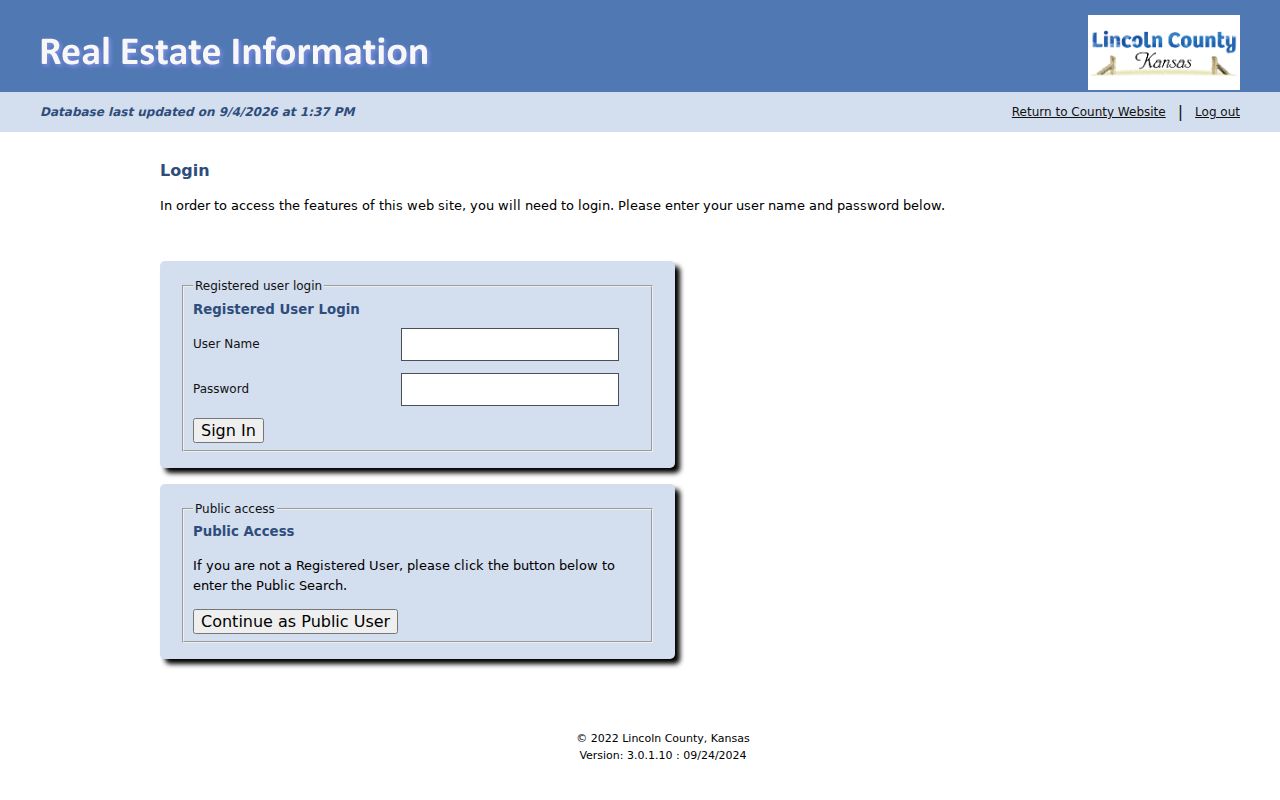
The public-user route leads to the detailed search form. The portal publishes no completed parcel card, so unverified result labels should never be assumed.
Types of Lincoln County Property Records
A complete Lincoln County file often crosses four county record families plus municipal material. Recorded instruments answer title language. Assessment data covers taxable characteristics. Tax statements show account status, while plats or GIS give geographic context.
| Record Type | What It Documents | Kept By | Access |
|---|---|---|---|
| Deeds, mortgages, liens, easements | Conveyance and recorded interests | Register of Deeds | Office request; no official online deed index was located |
| Assessment and parcel data | Displayed owner, identifiers, class, acreage, land use and appraised-value filters | County Appraiser | Public CAMA portal, phone, or office |
| Tax accounts | Taxpayer/name, years, current or delinquent filters, and property criteria | County Treasurer | Public tax search or Treasurer |
| Plats and parcel geography | Subdivision/legal geometry and orientation | Register of Deeds; Kansas GIS/ORKA | Recorded plat request plus public viewer |
| Building, floodplain, and zoning files | Municipal approvals and property-specific decisions | Applicable city clerk | City records request; Lincoln publishes permit and ordinance pages |
Use the Lincoln County deed records guide for recorded instruments. The property tax records guide covers account and protest details. Turn to parcel maps for boundary orientation, and let none silently substitute for another.
Lincoln County Tax Search Connects Names, Years, and Land
The tax form offers more than a name box. Select Real Estate rather than personal property, oil, gas, trucks, minerals, or state-assessed utilities. Then narrow the search by segmented CAMA, owner or taxpayer identification. A starting and ending tax year narrows it as well. Street components, subdivision with block and lot, section-township-range, and lease name also narrow results. Quick Reference does the same. A name-mode choice distinguishes Current Owner, Taxpayer, and Both. That choice matters. The named taxpayer need not answer the same question as the recorded grantee.
Two checkboxes restrict results. They limit output to properties with current taxes. They also limit it to statements with taxes due, whether current or delinquent. The form publishes no completed statement, so exact balance, payment, and printable-bill fields remain unlisted.
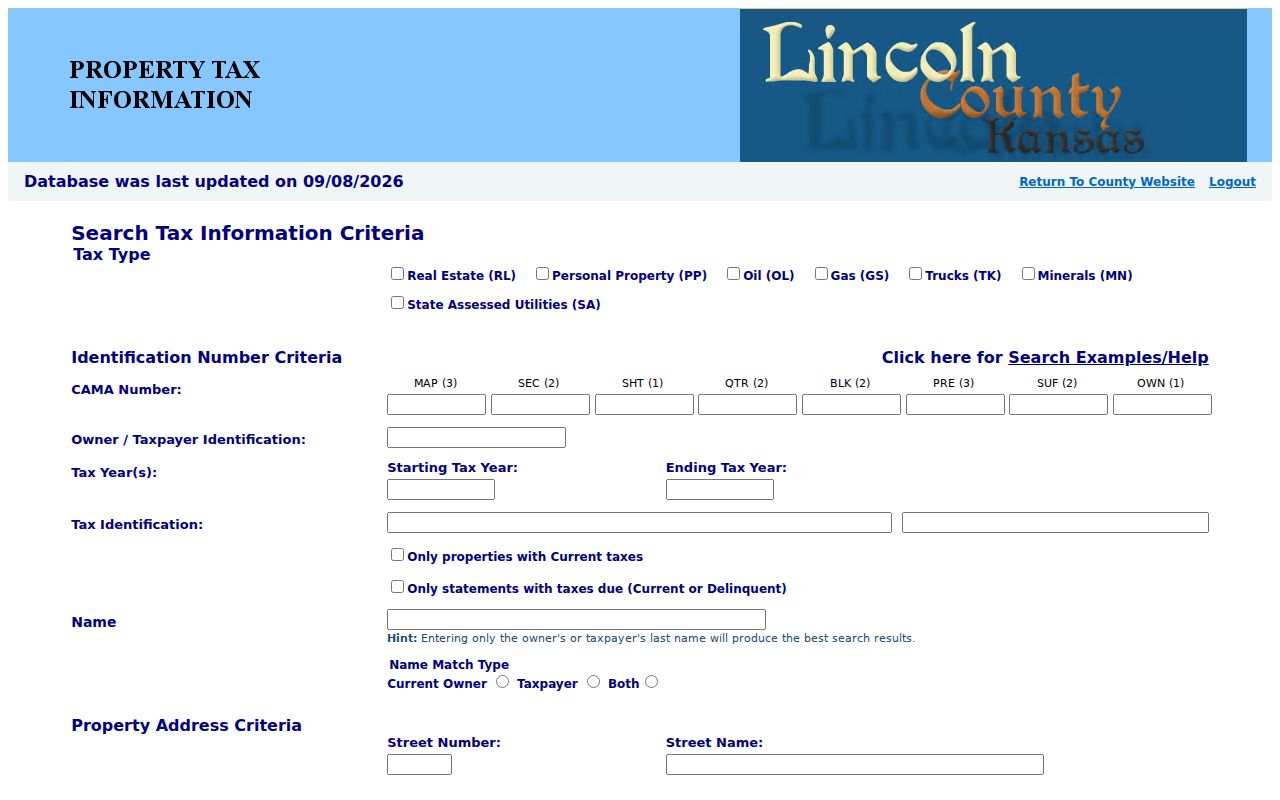
The form's identifiers bridge neatly back to appraisal data. The Treasurer remains the authority for a changing balance or sale status.
Deeds and Plats Still Require the Recording Office
The Register of Deeds records deeds, mortgages, oil and gas leases, platted additions, federal and state tax liens, mechanics liens on personal property, corporation papers, powers of attorney, county school records, and military discharges. The county publishes no online public deed index. That is an access gap. It does not mean the records are missing.
Use an Appraiser book/page, instrument, owner, subdivision, or tract lead when you request a search. Define the request by grantor or grantee, legal description, recording date range, book/page, or instrument number. Email, telephone, mail, and an in-person courthouse visit all work. The office's general page lists $0.35 per page. The detailed county fee schedule distinguishes letter at $0.25, legal at $0.35, tabloid at $0.50, and fax at $2 per page. No fee list settles every order. Confirm format, certification, and total before ordering.
See the county recording-office page:
The county's own recording-office page is the official route.
ORKA Maps Orient a Lincoln County Parcel
For parcel mapping, the Appraiser points visitors to Kansas GIS. The older ORKA route now lands on a current ArcGIS Experience viewer instead. State service metadata lists an ORKA service. The county publishes no detailed layer inventory, though. It offers no adjoiner, buffer, owner-card, export, or historical-imagery tool. Think of the map as a first stop for parcel adjacency, roads, water, and apparent rights-of-way. It is not a complete Lincoln County property records solution.
Inspect the current ORKA destination shown below:
A parcel number on the map means little by itself. Match it against the Appraiser and tax systems, then pull the deed, plat, easement, or survey before drawing any legal boundary conclusion.
Parcel map versus plat
That polygon is only an orientation layer. A recorded plat divides named land into lots and blocks, while a survey locates the actual lines on the ground, so the two answer different questions.
Lincoln County's January 1 Value Cycle
Lincoln County real property carries a January 1 valuation date. The Appraiser revalues every parcel annually. Inspections and remeasurement follow a cycle of at least six years. Building permits from the cities help the office track new construction between cycles. Valuation notices typically mail around March 1, unless the county uses an approved extension. From the mailing date, owners get 30 days for an informal appeal. That actual notice date, not the calendar's typical timing, sets each parcel's deadline.
The county tax calendar ties valuation, appeals, certification, and tax timing together. Check it for the current year's schedule. An old saved copy may miss a shifted deadline in Lincoln County property tax records.
Review the calendar page shown in this capture:
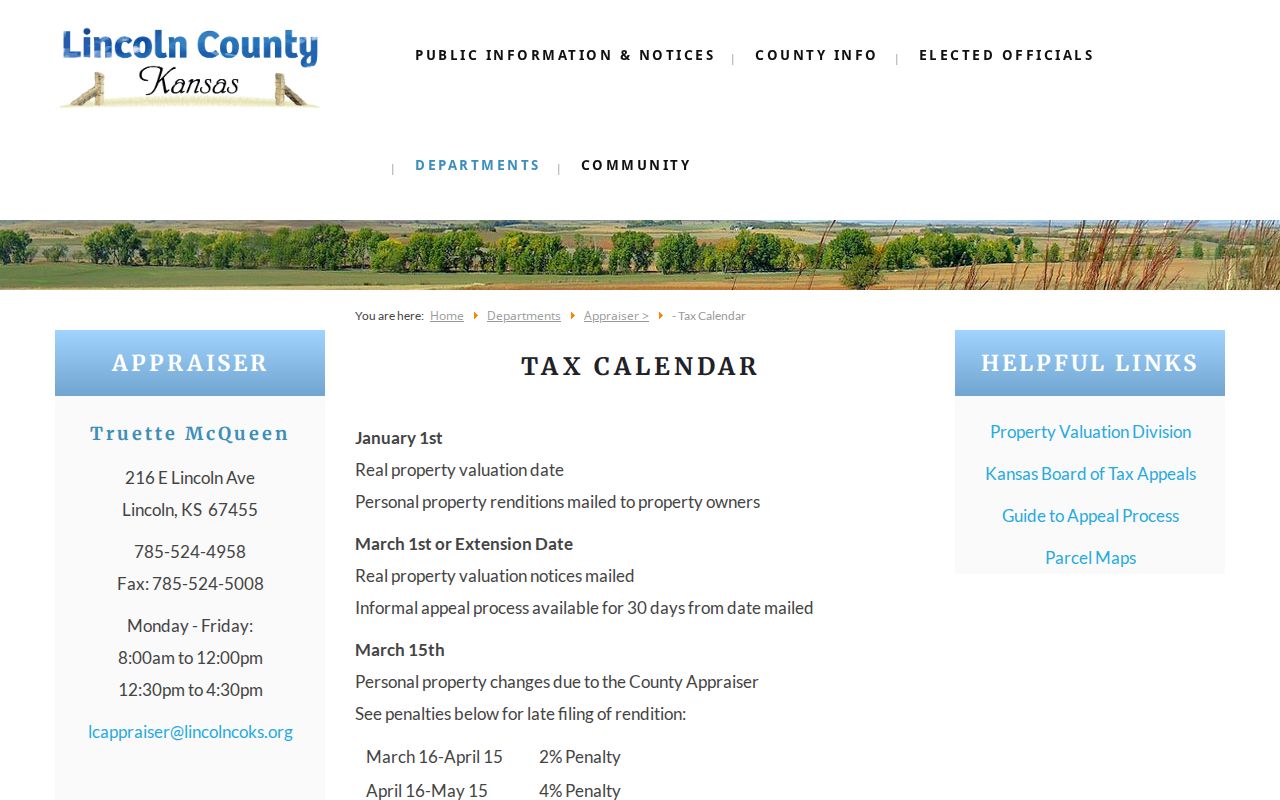
The calendar shapes the workflow, but the mailed notice and current county instructions govern any specific appeal.
Request Missing Lincoln County Records Under KORA
Kansas gives residents a formal path to records the county already holds. The County Clerk's KORA page explains that route under the Kansas Open Records Act. A strong request names a custodian, a record family, an identifier, and a date range. It also names a copy format. That keeps the response fast. The county cites three business days for most productions. Still, delays, lawful exemptions, staff time, copying costs, and advance payment can all apply.
Ask for something concrete. An appraisal card fits. Index entries, an instrument copy, and a tax statement fit too. A defined electronic export also works. KORA does not oblige the county to build a custom ownership history, a title opinion, or a new map. It need not produce an analysis or a compiled list of people. Any denial or delay deserves a written explanation. Recording records belong with the Register of Deeds first. The Clerk serves as the county FOI contact. The office is not a substitute custodian for every file.
Note: Save the exact query, returned identifiers, portal timestamp, and failed searches so an office request is reproducible.
The 1898 Courthouse Fire Is a Research Clue, Not a Blanket Gap
Lincoln County was established in 1867 and organized in 1870. An 1872 election picked Lincoln Center over Abram as the county seat. Per Kansas Historical Society history, fire destroyed the 1873 courthouse in 1898. The present limestone courthouse followed in 1900. That chronology guides an archival search. It does not prove that every earlier deed, tax roll, plat, or court record burned.
Start an old-property investigation with the current legal description and work backward. Search the State Archives, the archives catalog, and the newspaper database. Check the local historical society and the Register of Deeds by exact series and years. The KSHS county-microfilm roster does not clearly identify Lincoln County. Obtain a catalog title and a reel or volume number before counting on microfilm access. The KSHS microfilm access page explains how to request those materials.
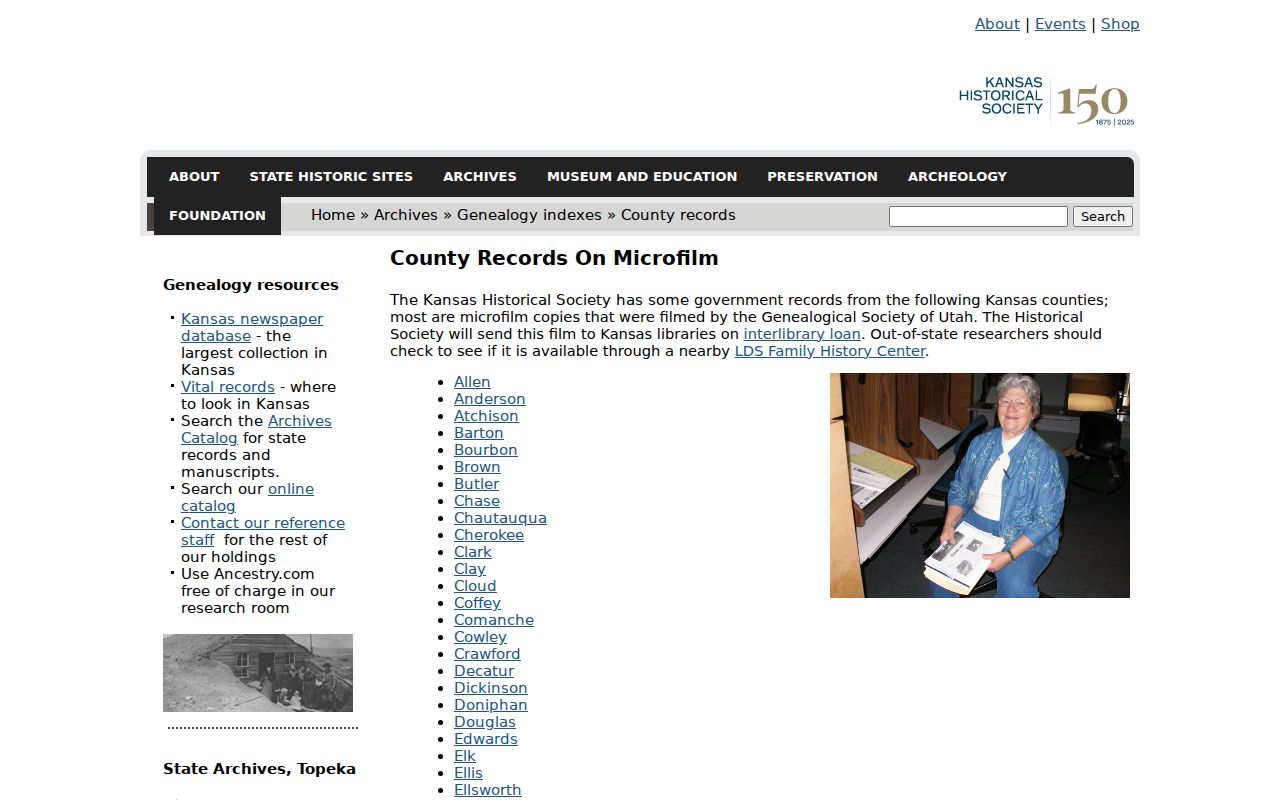
The page explains repository and interlibrary-loan routes; Lincoln holdings still require direct confirmation.
City Property Files Add Permit and Boundary Context
Deeds, assessment, and taxes for Lincoln Center, Sylvan Grove, and Beverly stay in county property records. City files add a different layer. They cover permits, floodplain review, zoning, subdivision decisions, street actions, and city limits. The City of Lincoln publishes routes to its permits, ordinances, and meeting minutes. Sylvan Grove posts a municipal profile with a clerk contact. Beverly offers only starting points. The city publishes no current property portal. Its state municipal-budget route and the KDOT map fill the gap.
Handle city labels with care. Census writes “Lincoln Center.” Municipal branding says “Lincoln.” A postal city never proves corporate limits. Historical Census material on annexations is not a current boundary map either. Keep the requested address, the portal's label, the USPS result, and a current city-limit source. Resolve conflicts openly rather than quietly normalizing them. Then continue with Lincoln Center, Sylvan Grove, or Beverly property records.
Lincoln County Market Evidence Has Local Limits
Lincoln County's 2025 market study found a 0.07% residential inflationary trend. Commercial and vacant categories held stable. Some land values rose around Wilson Lake and in Prairie View Estates. Actual sales drove those increases. Those findings describe the county as a whole, not any unsampled parcel.
To judge a lake-area or Prairie View parcel, compare class, acreage, land use, tax unit, and improvement status. Weigh them against real sale evidence. A recorded instrument or a sales-validation source can back up transfer research in the property records. An appraised value, a study trend, a tax amount, or an asking price never substitutes for a verified sale price. That distinction matters most in Lincoln County. There, a rural route, an estate name, a water feature, or a subdivision name often identifies land better than a street address.
Tax-Sale Research Is a Lincoln County Record Sequence
Kansas statute drives the August ritual in Lincoln County. The Treasurer publishes delinquent real-estate taxes in the official county newspaper for three consecutive weeks, citing the statutes on the county page. That notice is a stage, not a verdict. Publication alone proves no tax sale.
A defensible property-record chronology separates the delinquent account, the published notice, court foreclosure, the auction, any redemption, deed issuance, and final recording. Start with the current tax account and the Treasurer's collection guidance. The Kansas Historical Society newspaper database is next. Search it by county, publication title, name, legal-description terms, and the August range. Then trace the 12th Judicial District courts and the Register of Deeds for the judgment, lis pendens, sheriff's deed, or other instrument touching the parcel.
Never treat an old publication as proof that land is delinquent or sold today. Dates scatter. Notice, auction, court action, and recorded deed may fall in different years, while a tax portal balance can change after payment, adjustment, protest, or sale. Write the tax year beside every step. Add the source date too.
One Lincoln County Parcel Needs a Source-Date Bundle
A dependable parcel file keeps its dates separate: the Appraiser access date and database timestamp, the tax-search date, and the deed recording date. Also keep the municipal-file date and the GIS capture date separate. One blended "last updated" label hides the normal lag among independent systems. When a deed looks newer than the assessment display, the separate dates flag a possible refresh difference. They do not prove rejection, error, or delay.
Preserve the original address, the supplied owner or entity name, the city label, and every identifier exactly as given. Record the query type, spelling, result count, Property number, Quick Reference, CAMA format, and subdivision. Also note whether the match was unique. For a recorded instrument, note the document type, grantor, grantee, execution and recording dates, and book/page or instrument number. Include the legal description, referenced plat, easements, restrictions, and releases actually shown.
Keep direct evidence apart from inference. "The Appraiser displays" names the assessment source. "The latest recorded deed conveys to" names a recorded document. Calling the two the same land is a cross-source conclusion. It should rest on matching identifiers and legal descriptions. Unavailable fields and unresolved conflicts belong in a final note, together with the exact office and record needed next.
Limits of Lincoln County Property Records
Every Lincoln County office answers a different question. The Appraiser shows a displayed owner and taxable characteristics. The Treasurer identifies a taxpayer and account status; a deed names grantor, grantee, and conveyance language; a court docket documents a proceeding. No single record does it all. None of them alone establishes present title, beneficial ownership, occupancy, boundary location, or current market price.
Copy trusts, estates, corporations, and limited-liability entities exactly as shown. Names are records, not guesses. The Kansas Business Entity Search can identify entity filings and resident agents, but it is not a title record. A resident-agent address need not be the parcel address. A trustee, executor, manager, or attorney-in-fact may hold a recorded role without being the beneficial owner.
Lawful use. Lincoln County property records support purchases, estate work, boundary questions, appeals, and civic transparency. They do not replace a title examination or licensed survey, and owner information must never be used to harass or harm anyone.