
Find Out Who Owns Lincoln County Land
Three records settle the question. The Appraiser shows a displayed owner and parcel identity. The Register of Deeds holds the latest conveyance and the controlling legal description, while the Treasurer keeps the taxpayer or name entry. Reconciling those three Lincoln County sources separates discovery from proof and gives every answer a source date.
- Search the address in the Lincoln County Appraiser portal; if needed, separate the street components or search a subdivision.
- Capture the owner name exactly as displayed, Property number, Quick Reference, CAMA segments, and any book/page, instrument, or ownership-date lead actually shown.
- Ask the Register of Deeds for the latest deed matching that land, using the legal description and recording reference.
- Compare the grantee to the Appraiser display and the Treasurer tax search, which separates Current Owner, Taxpayer, and Both.
The Lincoln County Owner-Name Field
The Appraiser's verified search control is labeled "Owner name." It accepts any portion of a name. That freedom helps with initials, punctuation, trusts, and entity suffixes. But partial matches can return unrelated people. Narrow the candidate with address, subdivision, acreage, Property number, Quick Reference, or CAMA fields.
The portal also exposes Book, Page, Instrument Number, and Ownership Dates From/Through controls. Treat them as bridges to a recorded instrument. They are not proof of a transfer history. Nor do they promise an online deed image. A completed owner card may not open for every parcel. So no mailing address, transfer date, sale consideration, or card-history field should be promised.
See the public Appraiser entry used to begin an owner search:
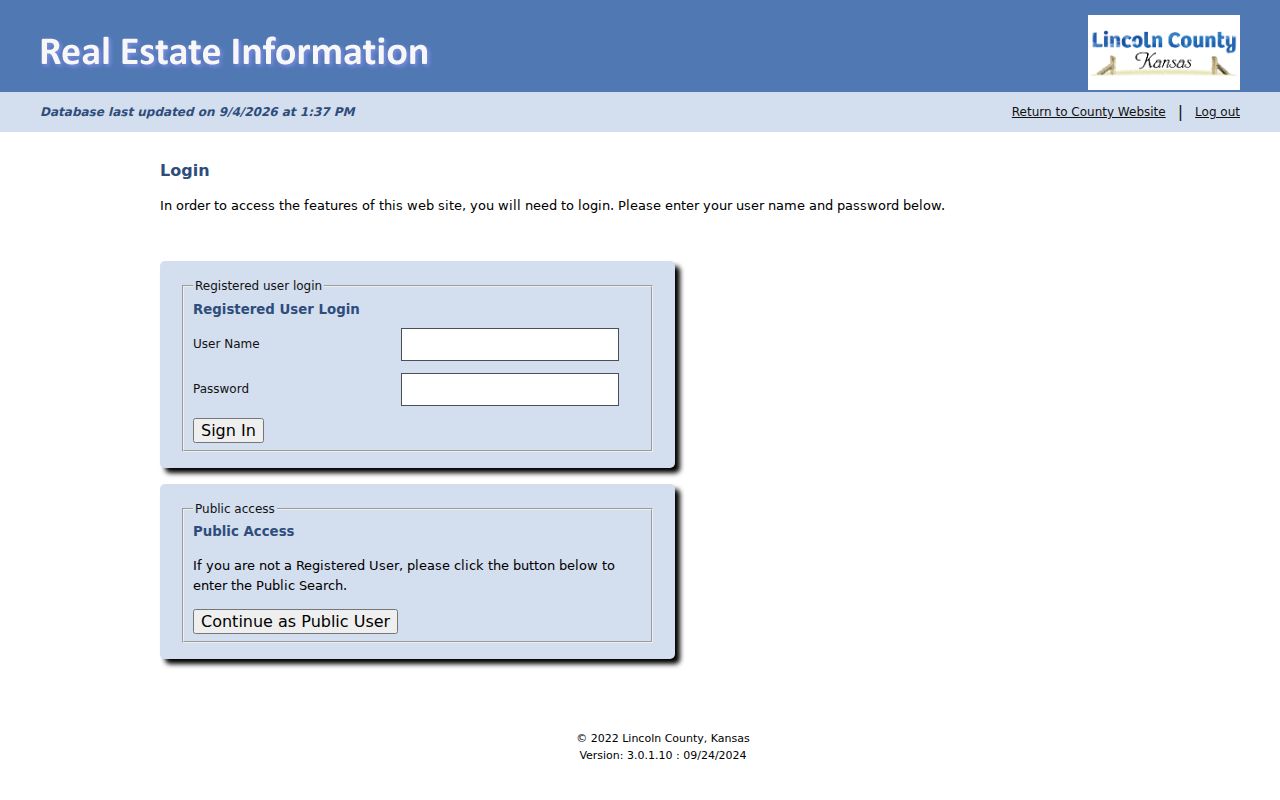
This screen opens the search; the deed settles ownership.
Where Lincoln County Ownership Names Appear
Every source names a role. The Lincoln County Appraiser, Treasurer, and Register of Deeds each capture a different legal fact, so label the result precisely instead of compressing every name into “owner.”
| Source | Owner Info It Gives | Access |
|---|---|---|
| Appraiser portal | Displayed owner tied to an assessment parcel | Public-user web search; office fallback |
| Register of Deeds | Grantee and conveyance language in the latest located deed | Phone, email, mail, or courthouse request; no online index verified |
| Treasurer tax search | Current Owner, Taxpayer, or Both according to selected name mode | Public tax portal or Treasurer confirmation |
| Kansas SOS | Entity filing, SOS ID, and resident agent | Public business-entity search; not title evidence |
An occupant may differ from every name in the table. A taxpayer can differ from the recorded grantee. So can a mailing recipient. Even when all three Lincoln County sources agree, attach their dates, because a recently recorded deed may post before an assessment roll refresh.
Confirm a Lincoln County Entity Owner
When the Appraiser displays an LLC or corporation, preserve the exact legal name and search it in the Kansas Business Entity Search by business name or SOS Business ID. A stray period can change the match. The system also searches current resident agents, with Contains or Starts With name matching. Results cap at the first 200.
An SOS filing separates similarly named entities. A resident agent is not automatically the property owner. The agent's address may be nothing more than a service address. Sole proprietorships and many assumed names are missing, so return to the recorded deed to verify which entity received the land and whether the legal description matches.
Ownership vocabulary
Displayed owner is the Appraiser entry. Taxpayer is the name on the tax account. Grantee is the party receiving an interest in a deed, while title concerns legal ownership interests and cannot be proved by one portal label.
Trust, Estate, and Representative Names Need Role Checks
A Lincoln County deed or assessment record may name a trust, estate, trustee, executor, manager, agent, or attorney-in-fact. Keep that role intact. The representative is not necessarily the beneficial owner. Public property records may not resolve private beneficial interests at all.
When an owner has died or a court order touched the parcel, the Kansas District Court Records route may surface a probate, quiet-title, partition, or foreclosure case. Lincoln County sits in the 12th Judicial District. A docket shows a proceeding. Look for the resulting judgment, fiduciary deed, sheriff's deed, or other recorded instrument at the Register of Deeds to confirm a completed transfer.
Parcel Changes Can Hide a Lincoln County Owner
Splits, combinations, and new plottings can produce new parcel numbers. The Appraiser warns that a current identifier may fail to expose the older assessment trail. A Lincoln County ownership search can stall. Follow the legal description instead. Check the subdivision, lot and block, section-township-range, instrument, and neighboring parcels.
Keep both rural and municipal labels handy. Census uses "Lincoln Center." The municipality brands itself "Lincoln." A historic township description will not settle current city limits. A postal city will not settle them either. This naming collision explains a missed address search, not two different properties.
Use a Specific KORA Request When the Portal Fails
The Lincoln County KORA page says requests should identify an existing record. Written requests work. Most come back in three business days. Lawful exemptions, staff time, copying or reproduction charges, and advance payment can still affect timing.
Ask the Appraiser for the existing card tied to one Property number or Quick Ref, including the owner “as displayed” and the record's date. Ask the Register of Deeds for index entries or copies tied to a legal description, grantor and grantee, book and page, instrument, and date range. Neither office should be asked for a custom conclusion. A conclusion is not a record. Precise requests keep records and opinions separate.
Three Addresses May Differ Without Proving Fraud
One Lincoln County parcel can carry three different addresses. The situs address describes the physical property, while the Treasurer tax roll lists a taxpayer mailing address and the deed names a grantee address. None of these is wrong by itself. A mismatch can reflect correspondence preference, escrow handling, rural addressing, an entity's service address, or simply an older record date.
Treat the discrepancy as a prompt. Compare source dates, the parcel number, the legal description, and recording information side by side. Never swap one address for another in silence. A mismatch alone never announces wrongdoing, and any claim about the owner of record must rest on the actual live record rather than an assumption about which address is current.
Use Confidence Labels for a Lincoln County Property Owner
A strong ownership note separates three confidence levels. The displayed owner comes from the Appraiser card for the assessment parcel. The taxpayer comes from the Treasurer search. The recorded grantee is the party to whom the latest deed transfers the described interest.
When all three names agree, confidence rises. The Property number, CAMA data, address, subdivision, and legal description should align too. Dates still matter. When the names differ, preserve the conflict and name the next evidence needed, whether a newer deed, a complete legal description, an entity filing, a probate instrument, or a current card. Picking one name without naming its source hides a material distinction.
Apply the same discipline to a common surname. Search exact and partial spelling variants across Lincoln County property records, then disambiguate through parcel context rather than unrelated personal details. A voter or license record offers limited identity context. None of those sources establishes ownership. The deed records and the assessment roll must carry the conclusion about who owns a property in Lincoln County.
Recent Deeds Can Be Newer Than the Appraiser Display
Lincoln County databases do not update in lockstep. The Appraiser portal shows a database-update timestamp, yet the county publishes no fixed lag between a deed's recording date and the owner display. A closing date, a deed execution date, a recording date, a tax-account change, and an assessment refresh can all differ. That gap matters most after a recent sale.
Record the portal timestamp. Then ask the Register of Deeds for instruments recorded after it. Compare each grantee against the subject parcel. An Appraiser ownership-date or instrument field is a useful lead. The recorded deed is the better source. Even that deed has limits. A deed naming a party still cannot resolve later unrecorded events or every question about title quality.
So date every answer by its source. Say the Appraiser displayed a name as of a certain date, and that the latest deed carries its own recording date. That keeps the property records auditable without implying the county databases synchronize instantly.
Tax Sales and Court Cases Require a Recorded Finish
Delinquent taxes move through separate stages. A published notice, a court foreclosure, an auction, a redemption, and a deed issuance are distinct events. Notices run three consecutive weeks in August. Foreclosure may follow the county's timetable. An old notice alone proves nothing about who owns the property now.
Check the current Treasurer tax account. Check for any deed or judgment recorded afterward. Probate, partition, quiet-title, and foreclosure dockets may explain why a name appears. A docket caption alone is not a conveyance, so the final answer comes from tying the court instrument or deed to the same legal description and parcel.
Limits of a Lincoln County “Who Owns” Answer
A public tax roll has real limits. It names a displayed owner but cannot show who occupies the address or reveal every beneficial interest held by a trust or entity. It cannot settle a boundary either. It does not guarantee clear title. Vital records, voter rolls, license files, and registries follow their own access rules, and a similar name in any of them never becomes proof of ownership in Lincoln County.
Lawful use. Use Lincoln County owner information for legitimate property research, purchase diligence, estate work, or civic transparency. Never use a public name or address to stalk, harass, intimidate, or harm anyone.