
Which Lincoln County Deed Records Fit the Question?
Read a conveyance by its actual document type. The Register of Deeds files mortgages, leases, liens, plats, powers of attorney, and corporation papers alongside Lincoln County deeds. Those neighbors can shape an interest. None of them is the deed that conveyed it.
| Recorded item | What it generally does | Useful research question |
|---|---|---|
| Warranty deed | Conveys the stated interest with deed warranties | What sale or transfer placed the grantee in the chain? |
| Quitclaim deed | Conveys whatever interest the grantor may hold | Was a possible interest released or adjusted? |
| Estate or trustee conveyance | Transfers under stated fiduciary authority | Does another estate, trust, or court file explain the authority? |
| Tax or sheriff-related deed | Records a transfer following the stated legal process | Do tax, court, and later recording dates complete the sequence? |
| Plat, easement, or restriction | Defines or burdens land without necessarily changing the owner | What description, access right, or covenant affects the parcel? |
The deed itself names the grantor and grantee. It also carries the recording reference and conveyance language. Compare that language against the legal description, since the Appraiser warns that a tax-appraisal description can differ from the Register of Deeds version.
Lincoln County's Recorder Holds More Than Deeds
The Register of Deeds lists a broad collection: deeds, mortgages, oil and gas leases, platted additions, federal and state tax liens, certain mechanics liens, corporation papers, powers of attorney, school records, and military discharges. UCC resources and former-register information appear on the office page too. That range shows why precision matters.
Classify each parcel result before you use it. A mortgage records financing, and its release or satisfaction belongs beside the original filing. An easement grants a route across land without conveying the parcel. A plat defines lots and blocks. An oil and gas lease touches only a limited mineral interest. Precision keeps a recorded name from being mistaken for the owner of record.
School records and military discharges explain why a broad surname search can pull material unrelated to a conveyance. Read the label first. Read the land description too. When a filing cites an earlier instrument, follow that reference and note whether the new document creates, amends, assigns, or releases the earlier interest. A hit is only a start.
Treat names exactly as written. Keep trust, estate, marital, and entity wording, plus initials, suffixes, and punctuation. If the Appraiser shows an entity as owner, a Kansas business search can identify the entity record. But the resident agent and business address never substitute for the grantee and land description on the deed.
Following Lincoln County Deeds Through Names and References
Lincoln County publishes no public online deed index. Start narrow instead. Pull a lead from the Appraiser portal, then ask the recording office for a defined index search. A request can run by grantor or grantee, legal description, date range, book and page, or instrument number.
- Use the current owner name, Property number, Quick Reference number, or instrument reference as a starting lead.
- Ask for the deed in which that party appears as grantee, and record both names exactly as indexed.
- Read the grantor from that instrument, then search that party as a grantee in the earlier transfer.
- Repeat while matching the legal description and keeping recording, execution, and closing dates separate.
- If the parcel was split, combined, or replatted, preserve both old and new descriptions and the filing that made the change.
- Grantor
- The party conveying the interest stated in the instrument.
- Grantee
- The party receiving that stated interest.
- Chain of title
- The linked series of recorded conveyances for the same land.
- Book and page or instrument number
- A reproducible reference used to retrieve a specific filing.
The Lincoln County Appraiser Provides Recorder Leads
The public Appraiser portal is an assessment system, not a recorder index. Still, it sharpens a deed records search. Its advanced form offers Book, Page, Instrument Number, and ownership-date fields beside the parcel identifiers.
| Appraiser field | How it helps a deed request | Limit |
|---|---|---|
| Owner name | Supplies a spelling to test as grantee | The displayed owner is assessment-side information |
| Property # or Quick Reference # | Keeps the county parcel lead with the request | It may change after portions, combinations, or new plotting |
| Book and Page | May point directly to a recorded reference | Confirm the cited document with the recorder |
| Instrument Number | Narrows retrieval to one filing | Document type and legal description still must match |
| Ownership dates | Frames a possible recording-date range | Assessment refresh and recording dates may differ |
Parcel numbers can change. Divisions, assemblies, and new plats all break the chain a current CAMA number implies. Follow the legal description and recorder references instead.
Lincoln County Copy Fees Need a Size Check
Check page size before paying for copies. The county's detailed fee schedule lists letter-size copies at $0.25 per page, legal-size at $0.35, tabloid-size at $0.50, and fax pages at $2. The summary page says $0.35 generally. That gap is one reason to name the size and delivery method up front.
Ask whether an electronic copy is available. Ask whether certification changes the price, whether staff search time applies, and whether advance payment is required. Never assume one flat rate. Tie any quote to the exact instrument and delivery choice rather than to every Lincoln County deed alike.
Say what product you want. An index entry is a locator and may omit terms that control the conveyance. A plain image supports research. Certification addresses the copy's official character, not whether the deed created good title, so let the custodian name the product and the total charge.
Staff may need to search. Give them name variants and date limits. Ask the reply to state the terms and index span checked, even when no match appears. A negative answer helps only when its scope is clear. It never proves a deed does not exist.
Four Ways to Reach Lincoln County Deed Records
Anyone needing Lincoln County deed records has one main stop. The Register of Deeds office in Lincoln handles them. The counter sits at 216 E Lincoln Ave. It is open Monday through Friday from 8:00 a.m. to noon, and again from 12:30 to 4:30 p.m. Call 785-524-4657, fax 785-524-5008, or email lcregdeeds@lincolncoks.gov. A deed records request can also move forward by mail. Include a written note describing the parcel number or owner of record being sought.
View the official recording-office page shown here:
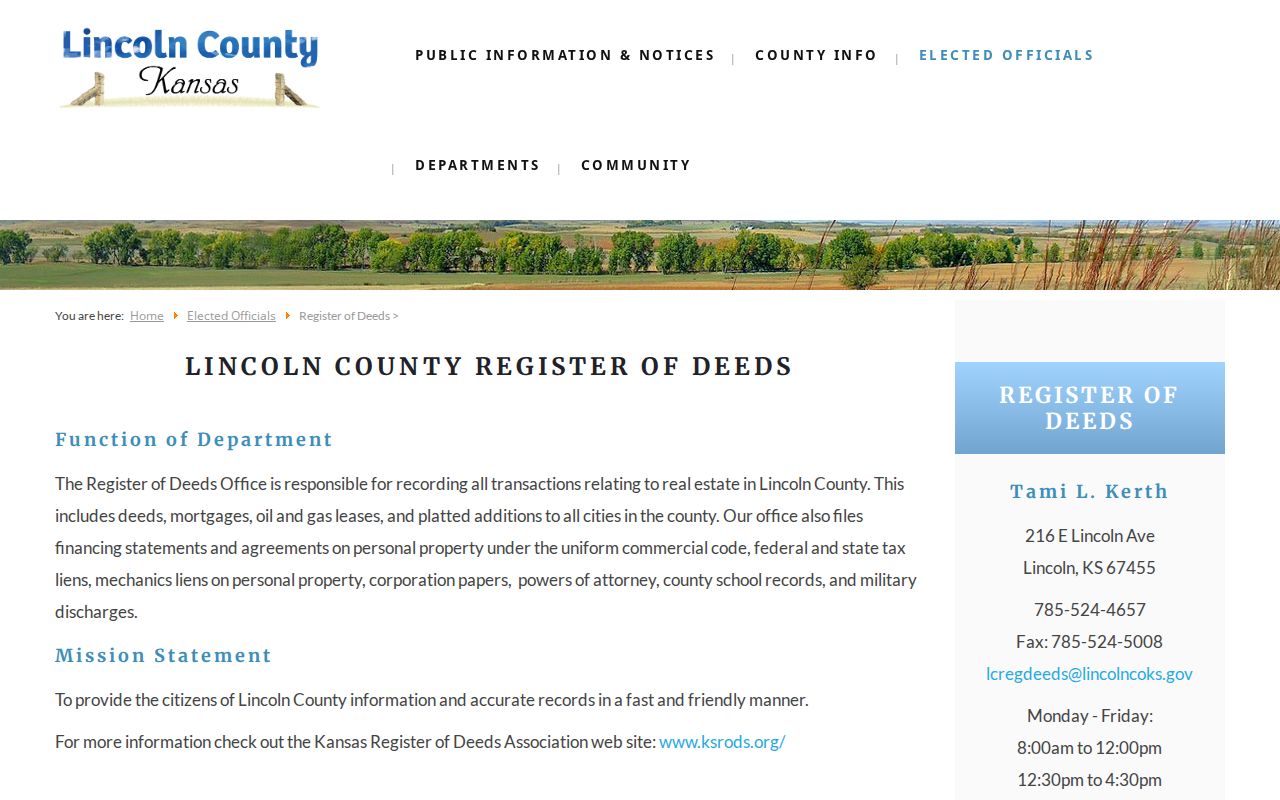
Ordinary contact with the office handles most deed records requests, but the county offers another channel when it does not. The county KORA route lets a requester ask in writing for an existing county record. Lincoln County states that most requests are produced within three business days. Fees and lawful exemptions can still apply, and advance payment may be required. KORA does not obligate staff to build a new ownership history or title analysis.
Recorded does not mean guaranteed. An index entry or deed copy shows a filing, not a title opinion, and unrecorded interests or later filings may matter.
Plats and Easements Add the Land Detail
A deed chain shows who conveyed what. Related Lincoln County filings often explain the land itself. For a plat, note the addition or subdivision name. Also note the lot and block, the recording date, the dedication text, and any restrictions the document references. For an easement, note which land benefits. Note which land is burdened, the purpose, the stated width or route, and any later release or amendment.
These details surface across the county. Names such as Wilson Lake Estate, Prairie View Estates, Lincoln Center additions, Beverly City, and Sylvan Grove appear in the Appraiser portal's subdivision control. Treat a portal label as a search lead only. The recorded plat or deed remains the authority for the legal land description.
Mortgage and lien research works the same way. Pull the initial filing. Then search for its release or satisfaction under the same parties and the same land. With an amended easement or a replat, keep the earlier and later descriptions side by side. That comparison makes the change visible. A later parcel number alone never proves the earlier chain ended.
Historic Lincoln County Deed Work May Leave the Web
The Kansas State Archives holds most of its collections on paper and film. They are not in digital form. The Kansas Historical Society offers catalogs, a research room, and newspaper holdings. It also provides county-record microfilm guidance for researchers. Its county microfilm roster does not clearly list Lincoln County. Treat no reel or year span as given.
For an older chain, ask the Register of Deeds, the State Archives, and the Lincoln County Historical Society which repository holds the deed book or index for the years in question. Request the volume, catalog, or reel identifier before traveling. A dead end online means only that the web route came up empty. The record may still sit in a drawer in Topeka or Lincoln.
No Verified Lincoln County Recording Alert Was Found
Lincoln County publishes no property-fraud notification service. That absence is not proof no program exists. Ask the Register of Deeds whether name monitoring or a recording alert is now offered. Ask also what enrollment requires.
An alert, where available, is only a prompt to look. It is not proof that a filing is valid or fraudulent. Keep the notice. Retrieve the instrument by its recording reference. Then compare the parties and legal description against the established chain.