
Compare Lincoln County Property Value Types
The label controls the meaning. Before comparing one figure with another record, keep the year, property class, and source written beside every value you copy from the assessor or the deed.
| Value | What It Is | Where |
|---|---|---|
| Appraised market value | The Appraiser's fair-market estimate for the annual tax cycle | County appraisal record |
| Assessed value | Appraised value multiplied by the Kansas rate for the parcel class | County appraisal record |
| Last sale or consideration | A past transaction figure, if the recorded instrument or live result states it | Recorded deed or confirmed parcel result |
| Land and improvement figures | Components that may explain the county estimate when displayed | Live appraisal card |
Assessed value is not a price in disguise. A sale reflects one transaction under its own conditions. Kansas sets different assessment rates by classification, and a future buyer and seller may still agree on an entirely different amount.
Apply Kansas Rates to Lincoln County Assessed Value
Kansas sets assessment rates by classification. Residential property sits at 11.5%. Agricultural-use land sits at 30%. Vacant lots and qualifying nonprofit property carry 12%, commercial and industrial real property 25%, public-utility real property 33%, and other property 30%. The parcel's actual class always controls. Never apply the residential rate to every tract.
The formula multiplies appraised fair-market value by the state rate to reach assessed value. The mill levy drives the tax afterward, but the bill belongs to a separate tax-record process, and this discussion stops at the valuation figures.
- Assessed value
- The tax base produced from appraised value and the applicable state rate.
- Market value
- The county's fair-market estimate for its stated cycle.
- Assessment ratio
- The class-based percentage applied under Kansas guidance.
- Reassessment
- The recurring process of setting a new value for a later cycle.
Date a Lincoln County Property Value Correctly
The Lincoln County Appraiser values real property as of January 1 and revalues it each year. Valuation notices are mailed by March 1 or an extension date, and the informal appeal window runs 30 days from mailing. Values are certified to the County Clerk by June 1. These dates identify the cycle; they do not turn an assessment into a current sale estimate.
Physical inspection and remeasurement occur at least once in six years. Building permits supplied by cities help the Appraiser track construction between visits. A changed structure detail, permit, parcel split, combination, or class can help explain why two annual property value records differ.
Follow the Appraiser tax calendar shown below for the official timing context.
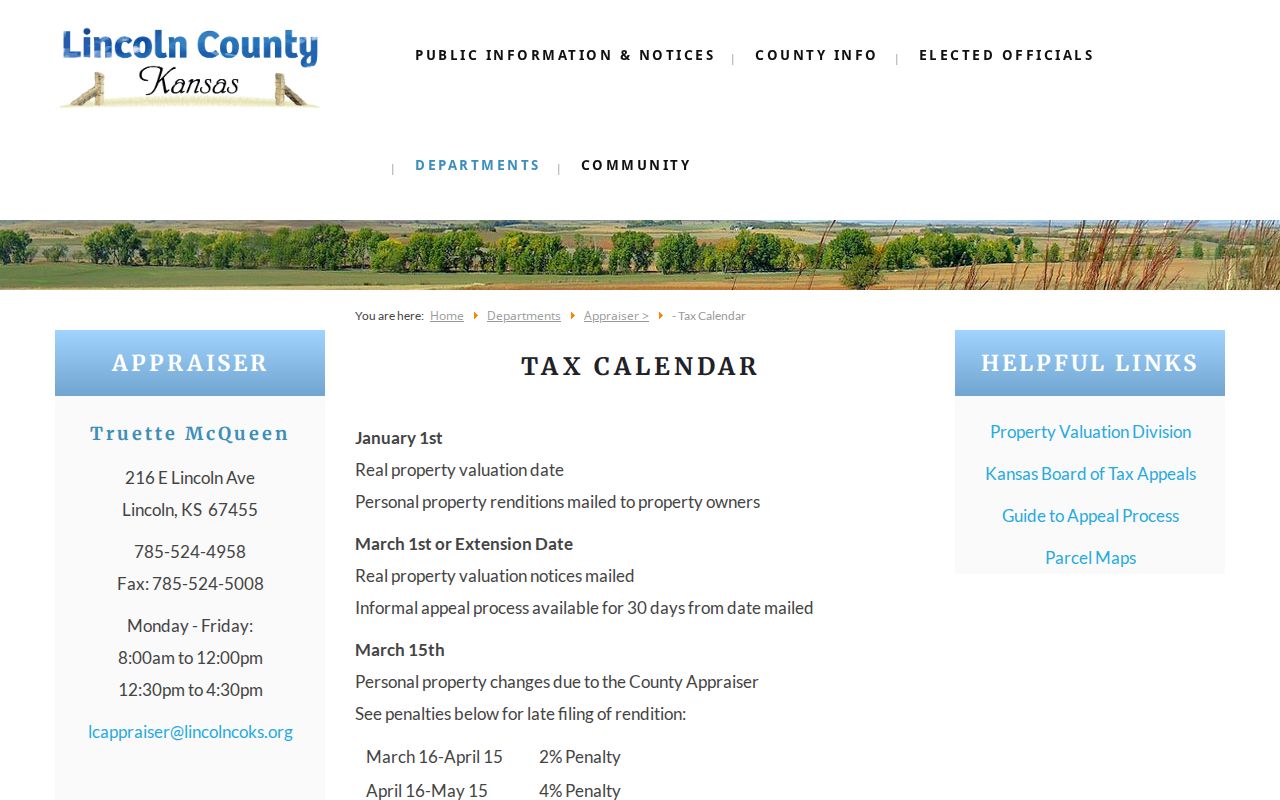
The calendar page ties each value to county deadlines. Check the live page for any later revision before relying on a date.
Estimate a Lincoln County Property Value from the Record
The Appraiser public portal provides the starting point. Read the live labels on the completed card rather than assuming which sale or improvement fields appear, and claim nothing the record itself does not show.
- Search by full address or its street parts, or use the Property number, Quick Reference, or CAMA segments.
- Confirm the parcel, class, acreage, tax unit, and value year before copying any figure.
- Label market or appraised value separately from assessed value and preserve the database access date.
- For a sale figure, inspect the recorded instrument and report only what it actually states.
- Sale consideration
- The amount or value stated by a transaction record, when available.
- Tax unit
- The local taxing geography connected to the parcel.
- Parcel class
- The category that determines which state assessment rate applies.
The portal offers more filters than an address box. It searches an appraised-value minimum and maximum, property class, acreage, soil unit, and land use, and those filters discover candidates rather than an appraisal of the subject.
Read Lincoln County's 2025 Market Study Narrowly
The county's 2025 market study reported a countywide residential inflationary trend of 0.07%. Commercial property ran stable to slightly upward. Vacant property held stable. The study also noted land-value increases at Lake Wilson and Prairie View Estates based on sales.
Those findings are trend evidence, not a parcel estimate. The study itself warns that individual properties differ because of improvements, comparable sales, and adjustments, so no countywide percentage should touch a house without its own record and relevant evidence.
Keep Lincoln County Value and Title Records Separate
The Appraiser offers a caution. A tax-appraisal description can differ from the legal description held by the Register of Deeds. A value search finds the parcel and assessment. It cannot settle title, acreage, or boundary questions alone. Parcel numbers may change after portions, combinations, or new plottings. When comparing older and newer values, bridge the records with the legal description, owner, subdivision, and instrument clues. Do not assume two numbers always describe different land. That habit keeps value comparisons honest. Title questions belong with the deed records rather than the tax roll.
Note: Preserve the portal timestamp. An annual value may change even when the physical property has not.
Compare Lincoln County Values with a Dated Log
A sound comparison logs the basics. Record the parcel identifier, class, valuation year, and access date. Log the database timestamp, appraised value, assessed value, and the source of any sale figure. Note whether the land was split, combined, or newly platted between the two dates. Improvement or reclassification matters just as much. Without that context, a percentage change can join unlike records.
Match property class first when comparing two parcels. Assessment ratios mean little across classes. Compare acreage, land use, and structure age only when the live cards display them. Improvement details and tax unit deserve the same caution. The Appraiser lists ownership, tax district, valuation, improvements, and structure age among the property information. Exact labels must come from the live record.
Log a failed address query too. Direction words, suffixes, or postal city can change the search path. An old address, a non-addressed tract, or a new parcel number can too. Try Property number, Quick Reference, CAMA segments, subdivision, acreage, or land-use criteria next. Those tools can isolate the same parcel across years. Only after that step are two Lincoln County values truly comparable.
Separate Lincoln County Sale Price from Assessment
The Appraiser portal offers search controls for book, page, ownership date, and instrument number. No completed transfer-history display or sale-price field appears there. Treat those controls as leads. When a transaction figure matters, request the recorded instrument from the Register of Deeds. Report the label and amount the document itself states.
Recorded consideration is not always a market price. Family transfers, entity reorganizations, estate conveyances, and partial interests. Each can shape the amount in a deed. Some instruments convey something other than full fee title. Before tying a figure to the whole parcel, compare the legal description. Check it against the interest actually conveyed.
The Register of Deeds takes focused requests by grantor or grantee, legal description, recording range, book and page. Instrument number requests work too. Assessment-side references can shorten that search. Ask for the existing instrument rather than a custom price analysis. Keep its recording date separate from the Appraiser's January 1 valuation date. Transaction evidence and the annual tax estimate then stay in their proper roles.
Know What Lincoln County Assessed Value Cannot Say
The Appraiser's figure exists for tax administration. It does not promise what a parcel would sell for, establish condition on a later sale date, or replace an appraisal prepared for a specific transaction. Last sale consideration does not forecast the next price either.
Value versus price. Lincoln County assessed value is for taxation, not a prediction of what the property will sell for, and it is not an appraisal.
A county estimate earns trust when you know its date and class. It shows how Lincoln County treated the parcel in that assessment cycle. That makes it a steady baseline for comparing earlier county records across years. What it cannot do is read a private transaction. Price reflects conditions, terms, and motivation that no assessor sees.
When two figures disagree, compare their effective dates first. Compare sources and labels next. Only then compare amounts. A January 1 assessment is one data point. A deed recorded months later is another. A current asking price is a third. All three can be honest answers to three different questions.
Keep classes matched, too. A residential parcel, an agricultural tract, a vacant lot, and a commercial site can carry different assessment rates. This holds even when their appraised values look alike. Structure details may come from a later inspection or permit update. A mailing-address change may shift nothing about physical value. Before drawing any trend, preserve the basics. Save the value year, class, acreage, improvement description, and database access date. If the live card omits a field, ask the Appraiser for the existing appraisal record. Do not reconstruct it from a tax bill or a map popup.
For exemptions, see the Lincoln County property tax records guide. It also covers payment dates and the protest route. Separating those tasks matters. It keeps a mill levy or exemption from being mistaken for a swing in market value.