
Check Lincoln County's Owner of Record
The Lincoln County Appraiser public portal labels its owner criterion Owner name. Any portion of a name works. The Appraiser states that county property information covers ownership and tax district. It also lists valuation, improvements, and structure age. The portal publishes no completed public parcel card. So read the exact result labels from the live record rather than guessing at them. Treat this inventory as a checklist for judging a current owner result. Each field either identifies the parcel or dates the ownership view.
| Owner name | The name displayed on the assessment side; preserve spelling and entity or trust wording exactly. |
|---|---|
| Mailing address | The destination used for owner correspondence, if displayed; it may differ from the land's location. |
| Situs address | The physical property address used to match the person or entity to the right parcel. |
| Property identifiers | Property number, Quick Reference number, and segmented CAMA fields that bridge county systems. |
| Instrument lead | Book, page, instrument number, or ownership date, when a live result supplies one. |
| Record date | The portal database timestamp and access date needed to judge how current the display is. |
A displayed owner is not always an occupant. The situs address is not always where mail goes, either. A parcel may sit in a trust or belong to a company. Its owner of record may receive notices at a second address entirely. Keep both addresses in your notes. The owner question is answered best when the name, the parcel number, and the newest recorded conveyance all point to the same piece of Lincoln County land.
How Fresh Is a Lincoln County Current Owner Entry?
Lincoln County revalues real property annually, with each valuation dated January 1. That cycle has nothing to do with how fast ownership changes post. The county gives no set number of days for a newly recorded deed to reach the Appraiser roll. No source promises one, either. So a fresh conveyance may lag behind the paperwork for a while. Treat any timestamp on the portal as proof only that the database was refreshed. It is not proof that every recent deed and owner of record entry has been posted.
Freshness check. The assessment roll can trail a recent sale; the newest recorded deed is the better source for the latest grantee.
A mailing address can change with no deed at all. A parcel number can change after land is split, combined, or newly platted. Both are record changes, not automatic evidence of a new owner, so save the search date and identifiers before comparing versions of the roll.
Lincoln County Owner Fields That Narrow the Match
A partial owner name can return several candidates. The public form supplies independent checks that keep a common surname or entity tied to the correct parcel in Lincoln County property records.
| Portal field | Best use | Caution |
|---|---|---|
| Full Address | Match the known site | Test separate street parts if the full form fails |
| Property # / Quick Reference # | Carry a stable identifier | A split or combination can create a new number |
| Book / Page | Follow an assessment-side deed lead | Verify the actual instrument with the recorder |
| Ownership dates | Narrow a known transfer period | Do not invent a transfer date from a blank result |
| Instrument Number | Match a recorded reference | The recorded document controls its own meaning |
The portal also accepts CAMA segments, subdivision, property class, acreage, and tract criteria. Property Search owns the full form tour. For a current owner check, use just enough fields to isolate the parcel. That keeps the returned identity clean. The public-user entrance to the Appraiser search takes you straight to the form.
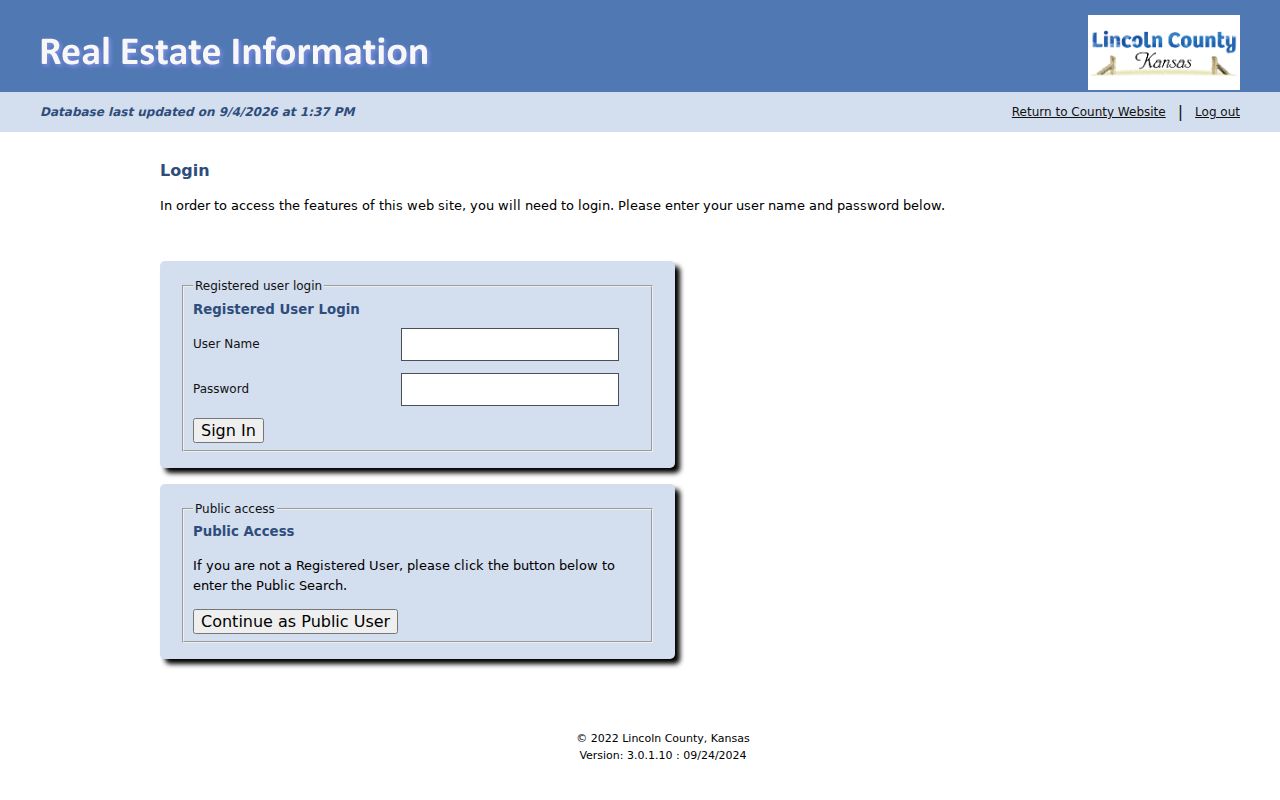
The official portal page shows the access route and its search fields. A live property search is still needed to see the current owner result and the database date behind it.
Verify a Lincoln County Entity as Current Owner
When the roll shows a company, copy its punctuation and legal ending exactly. The Kansas Business Entity Search accepts a business name, a Kansas SOS Business ID, or a current resident agent. It also offers Contains and Starts With matching. Results stop at the first 200. Sole proprietorships and many assumed names do not appear there at all.
- Owner of record
- The person or entity displayed by the county for assessment administration.
- Assessment roll
- The county inventory and value record for a stated cycle.
- Situs address
- The location of the parcel, distinct from an owner's mailing address.
- Recording lag
- The period between a conveyance and its appearance in a downstream county system.
A resident agent receives legal service for the entity. That role does not make the agent the owner, occupant, or property contact. A trustee, executor, manager, or attorney-in-fact may likewise hold a legal title without resolving beneficial ownership in the deed records.
Verify Lincoln County's Current Owner Against the Deed
The Appraiser gives the assessment-side lead. The Lincoln County Register of Deeds holds the recorded conveyance and the controlling legal description. The county publishes no online deed index, so confirmation may require a focused office request.
- Search the Appraiser roll by address or partial owner name, then copy the displayed owner and parcel identifiers.
- Ask the Register of Deeds for the most recent instrument tied to that grantee, legal description, book/page, or instrument number.
- Compare the deed's grantee and legal description with the roll, noting each source date and any mismatch.
- If the grantee is an entity, use the Kansas filing search only to clarify the entity record, not to replace the deed.
- Grantee
- The party receiving the interest described in a recorded conveyance.
- Vesting
- The document language describing how an interest is held.
- Registered agent
- The filing contact for a Kansas entity, not proof of title.
Ask for an existing instrument or a defined index search by grantor or grantee. A legal description, recording range, book and page, or instrument number works too. The office lists weekday hours of 8:00 to noon and 12:30 to 4:30. It sits at 216 E Lincoln Ave. Phone access is 785-524-4657, and email is lcregdeeds@lincolncoks.gov. Mail and in-person requests remain the reliable route while no web index exists.
When Lincoln County Owner Descriptions Differ
The Appraiser warns that its tax-appraisal description may differ from the legal description the Register of Deeds maintains. Copying a shortened tract line into a purchase, boundary, or easement decision can overstate what the assessment record proves. Match the identifiers first. Then read the recorded description in the deed records. If the owner name agrees but the parcel geography does not, check for a split, combination, or new plat. If the geography agrees but the names differ, compare dates. Then locate the latest conveyance rather than trusting the newer-looking screen. Report the county record as a dated source and explain the difference. Note: A tax description is a useful parcel clue. The recorded deed supplies the legal wording that controls the conveyance.
Request a Missing Lincoln County Owner Record
When the public portal cannot produce a usable card, contact the Appraiser at 216 E Lincoln Ave, Lincoln, KS 67455, 785-524-4958, or lcappraiser@lincolncoks.org. Ask for existing appraisal-card fields for a specific property number, including the owner as displayed, addresses as displayed, tract description, class, acreage, value, and available instrument fields.
For a broader existing county record, the County Clerk's Kansas Open Records Act route accepts specific requests. The county says most are produced within three business days, though copying, staff, and reproduction costs may apply and advance payment may be requested. KORA does not require the county to create a new current-owner analysis.
The fallback chain is practical: public portal, Appraiser phone or counter, Register of Deeds request, then a narrow KORA request for an existing record. Preserve failed queries, because an abbreviation, old address, non-addressed tract, split parcel, or session issue may explain the failure.
A good request log lists the query string, search type, access time, database timestamp, returned Property number, Quick Reference number, CAMA segments, subdivision, and whether the portal produced one match or a list. Keeping unsuccessful attempts beside the successful one can explain why an owner name seemed to disappear. It also gives Appraiser staff enough detail to reproduce the issue without creating a new ownership report.
When the portal and deed use different parcel references, retain both. Ask which identifier belongs to the appraisal system and which belongs to the recording system, then connect them through the legal description. This matters most after a split, combination, or new plat, since Lincoln County can assign a new parcel number while older deeds retain the description used at recording.
Use Lincoln County Current Owner Data Lawfully
A mailing address printed in a public record can help with a legitimate property question. It does not establish where a person lives. Protected identifiers and exempt records can limit disclosure in Lincoln County. Address-confidentiality rules can too. Ask a custodian for the lawful record rather than trying to defeat a redaction.
Lawful use. Use Lincoln County current owner data for legitimate property diligence and civic research. Never use it to harass, intimidate, stalk, or target a person.
The tax roll is an assessment tool. It is not a title search, and it is not a directory of occupants. For the wider address-to-owner method, see the Lincoln County owner-finding guide; this page stays focused on validating the name shown now.